Copier Automation · Jul 20, 2026 · 5 min read
Master-Slave Copying Explained: The Failure Modes Every Multi-Account Trader Should Know
E.A Victor
Founder, Trading Solutions by E.A Victor
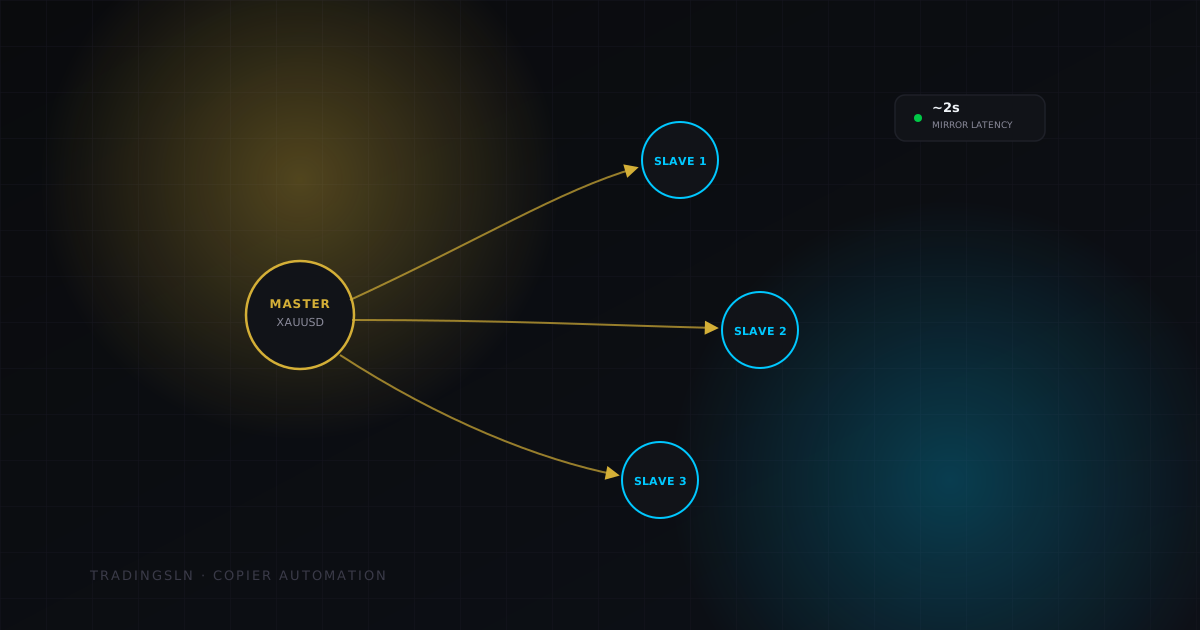
Mirroring trades from one account to another sounds simple: a position opens on the master, the same position opens on the slave. In practice, the failure modes only show up once you're running multiple accounts with different balances, different brokers, and different symbol conventions at the same time — which is exactly the scenario copying exists for.
There are five places this breaks. Know them before you connect a second real account, not after.
1. Symbol suffix mismatches
Most brokers append their own suffix to symbol names — EURUSD becomes EURUSD.m, EURUSDpro, or EURUSD_i depending on the broker. A copier that maps symbols literally will silently fail to open a position on the slave the moment the master and slave use different suffixes, because as far as the software is concerned, "EURUSD.m" and "EURUSD" are different instruments. A properly built copier auto-detects each account's suffix and maps between them; a naive one just breaks quietly, and you find out when you notice the slave account has no open position for a trade the master clearly took.
2. Lot sizing across unequal account balances
Copying the exact same lot size from a €50,000 master to a €2,000 slave account either massively over-leverages the small account or, sized the other way, makes the master's positions meaningless on a large one. Here's the arithmetic: if the master opens 2.0 lots representing 1% risk on its €50,000 balance, mirroring that same 2.0 lots onto a €2,000 slave means the slave is risking roughly 25× its intended percentage on that one trade — a position sized correctly for one account can be catastrophically oversized on another. The fix is proportional sizing — by balance ratio, by a fixed risk percentage, or by a multiplier you set per slave — never a 1:1 lot copy across accounts of different size.
3. Partial closes that don't mirror
If the master closes 50% of a position and the copier only handles full opens and full closes, the slave account silently keeps a stale position the master no longer holds at that size. This matters more than it sounds — a strategy that scales out at multiple take-profit levels will produce a slave account whose risk profile drifts further from the master with every partial close that doesn't propagate.
4. Reconnection and duplicate opens
A dropped connection between the copier and either account is a certainty over enough time — a broker server hiccup, a VPS reboot, a brief internet outage. What happens on reconnect matters more than what happens during the outage: a naive system that resyncs by re-scanning current positions can mistake a position that was already copied for a new signal and open it a second time. A properly built resync uses an idempotency check — some form of "have I already handled this specific master position" — so reconnecting never produces a duplicate.
5. Orphaned pending orders
If the master cancels a pending order that was mirrored to the slave, does the copier cancel it there too? A copier that only tracks open positions and ignores pending-order state will leave stale pendings sitting on the slave account indefinitely — orders that can trigger days or weeks later, at a price level that made sense when the master placed it and makes no sense anymore.
Read-only versus full-access credentials, and why both exist
A master account only ever needs to be read from — the copier watches it, never trades on it — so a read-only investor password is both sufficient and safer, since it can't place trades even if something went wrong. A slave account, by contrast, needs a full trade password, because placing the mirrored trades is the entire point. This is our own copier's exact split, and it's inherent to how account-to-account copying works with any provider, not a design choice unique to us. If a copier is asking for a full trade password on what you intend to be a source-only account, that's worth questioning.
Key takeaways
- All five failure modes are normal operating conditions of running more than one account, not exotic edge cases.
- Symbol mapping and lot-size proportionality are the two most likely to bite on day one; reconnection idempotency is the one most likely to bite months in, quietly, after everything has "worked fine" for a while.
- A copier's real quality shows up in how it handles exactly these five cases, not in how cleanly it mirrors a single trade on two matched demo accounts.
TIP
Before trusting any copier — ours or otherwise — with real accounts, deliberately trigger a few of these scenarios on demo: force a disconnect mid-trade, close half a position on the master, use two accounts with different symbol suffixes. If it handles all three cleanly, it's handling the cases that actually matter.
FAQ
Does proportional sizing mean every slave account risks exactly the same percentage as the master? Not necessarily the same percentage — that's one common mode (risk-parity), but you can also set a fixed multiplier per slave or size by balance ratio, depending on how you want each account to relate to the master. What all three approaches share is that none of them copy the master's raw lot size unmodified.
What happens if the connection drops mid-trade and I'm not watching? With a properly built resync, nothing changes for you — on reconnect, the copier checks its own record of what it already opened before acting on anything, so the position stays exactly as it was rather than getting duplicated or lost. This is precisely what the idempotency check above exists to guarantee.
Do I need a read-only password for the master even if I trust myself not to trade on it manually? Yes. It's not about trust in yourself — it's that a read-only credential is strictly safer regardless of intent, and there's no functional downside since a master account is never supposed to receive trades from the copier anyway.
Related posts
Trading Education
What Should Never Be Automated: The Boundaries Between a Trading System and a Trading Decision
Platform Tutorials
Demo-to-Live: A Proper Soak-Test Protocol Before You Trust Automation With Real Money
Platform Tutorials